


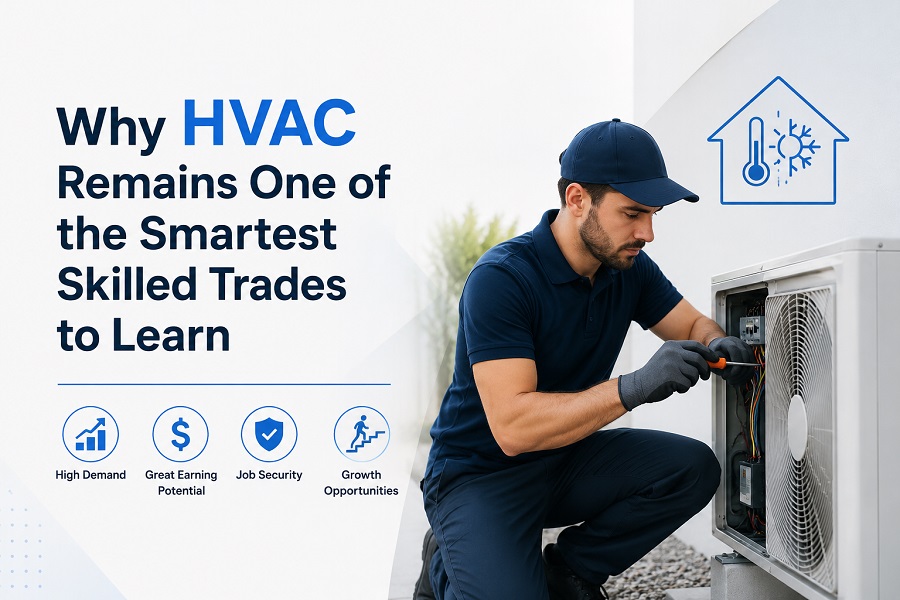
When students weigh their options after high school, the conversation often jumps straight to a four year degree, sometimes without a serious look at the alternatives. That is a shame, because some of the most stable and rewarding careers available today sit in the skilled trades. Heating, ventilation, and air conditioning work is one of the clearest examples. It offers steady demand, hands on problem solving, and a path that does not require years of student debt to get started.
For anyone exploring technical education, HVAC deserves a real look. Here is what makes the field worth considering and what a strong training path actually involves.
A trade the economy cannot outsource
Every building with climate control eventually needs someone to service it. Homes, hospitals, schools, restaurants, and data centers all rely on systems that require installation, maintenance, and repair. That work happens on site, which means it cannot be shipped overseas or handed to software. As long as people need comfortable indoor spaces, they will need trained technicians to keep those systems running.
The workforce is also aging, and a large share of experienced technicians are approaching retirement. That creates real opportunity for younger workers entering the field now. Demand tends to hold steady even when other parts of the economy wobble, because a broken system in July is not a problem anyone can postpone.
What the training actually covers
Good HVAC programs blend classroom theory with plenty of practical work. Students learn the science of how heat moves, how refrigerants behave, and how electrical and mechanical systems interact. They also spend real time with tools, wiring, gauges, and actual equipment, because this is a trade you learn with your hands as much as your head.
Certification matters here. Handling refrigerants requires specific credentials, and employers look for graduates who understand safety codes and diagnostic procedures. A quality program prepares students not just to pass those exams but to walk onto a job site and be useful on day one.
Learning the equipment, not just the theory
One thing that separates a confident technician from a hesitant one is genuine product knowledge. Knowing how a system works in the abstract is useful, but knowing the actual brands, models, and configurations on the market is what earns trust with customers and employers. Students who take the initiative to study the equipment landscape put themselves ahead.
Spending time with a dedicated resource for the best hvac equipment helps learners connect classroom concepts to the real products they will install and service. Understanding why one unit differs from another, how efficiency ratings translate into performance, and what features matter for different spaces turns textbook knowledge into practical judgment. That kind of fluency is exactly what sets apart the technicians customers want to hire.
Understanding the market you will work in
The HVAC field is not only about wrenches and wiring. It is also a business, and technicians who understand the supply side of that business have an edge. Equipment is increasingly bought and sold online, homeowners research their own options before calling anyone, and the companies that sell hardware live and die by their reputations.
Even reviewing how retailers operate is instructive for someone entering the trade. Looking through an assessment of ac direct and similar sellers shows how shipping, warranties, and customer support shape the buying experience your future clients are going through. A technician who understands that experience can guide customers better, answer their questions honestly, and position themselves as a genuine advisor rather than just a pair of hands.
A path with room to grow
The trade also rewards ambition. A technician who starts in the field can move into specialized installation, system design, project management, or running their own business. The skills transfer, the demand stays strong, and the ceiling is set more by drive than by credentials. Many successful contractors started exactly where today’s students are, learning the fundamentals in a training program before building something of their own.
The bottom line
Career and technical education exists to prepare people for real work that real employers need, and HVAC checks every box. It is stable, hands on, resistant to outsourcing, and full of room to advance. For students and career changers weighing their options, a trade that keeps the modern world comfortable is worth a serious look. The classroom is where it starts, but the opportunity is genuinely wide open.